

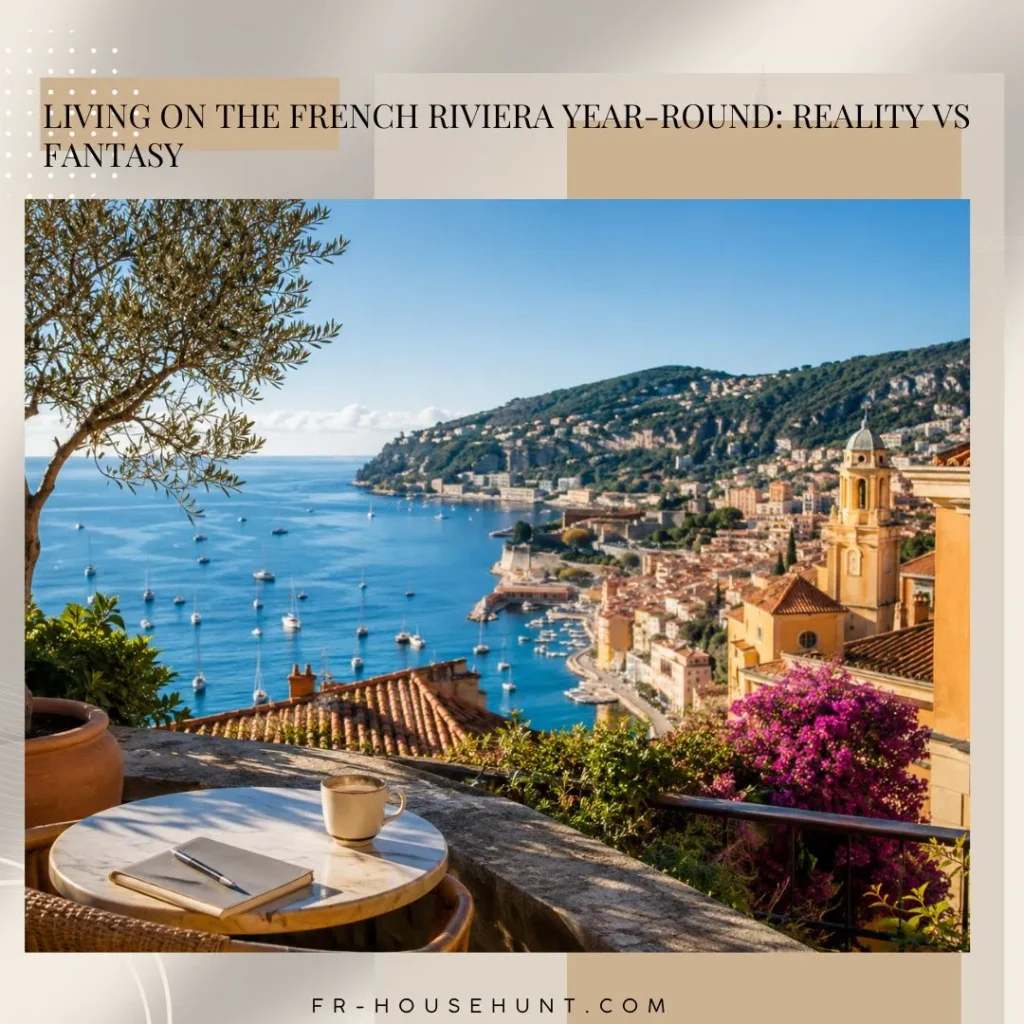
Dreaming of living on the French Riviera? Discover what year-round life is really like
If you’ve ever searched “living on the French Riviera”, chances are you’ve seen the same images.
Crystal-clear water. Luxury yachts. Colorful villages. People sipping rosé on a terrace while watching the sun disappear into the Mediterranean.
And here’s the good news: None of that is fake.
The French Riviera really is one of the most beautiful places in the world. But here’s what Instagram doesn’t show you.
It doesn’t show you Tuesday morning grocery shopping. The plumber who’s running “just a little late” (which, in France, is a wonderfully flexible concept). The January rain. The school run. The annual property tax bill.
Or the moment you realize you’ve just spent ten minutes discussing cheese with your local cheesemonger… and somehow enjoyed every second of it.
Because living on the French Riviera is very different from vacationing here.
And honestly?
That’s exactly why so many people end up staying.
Let’s separate fantasy from reality.
Fantasy #1: Every Day Feels Like a Holiday
We understand where this comes from. You’re surrounded by palm trees. The sea is five minutes away. People are eating lunch on terraces in February.
Surely life becomes one endless vacation?
Not quite.
Life still happens. You work. You pay bills. You wait for deliveries. You take the car for its annual inspection. You occasionally forget why you walked into the kitchen. (The Riviera hasn’t found a cure for that one yet.)
The difference isn’t that responsibilities disappear.
It’s that your environment changes the way you experience them.
Walking home after work along the Promenade des Anglais feels different from walking through an industrial business park.
Saturday grocery shopping followed by a swim in the Mediterranean feels… surprisingly efficient.
Practical Tip
When choosing where to live, imagine an ordinary Wednesday—not your perfect vacation day. Ask yourself: Would I still enjoy living here when I’m simply running errands?
Fantasy #2: It's Always Summer
Let’s be honest.
The French Riviera has one of the most pleasant climates in Europe.
With around 300 days of sunshine per year, you’re going to enjoy a lot more blue skies than most people living in Northern Europe, the UK, or North America.
But no…
It’s not always summer. Winter exists. Trees lose their leaves. Some mornings are crisp. It rains from time to time. And yes, you’ll occasionally need a proper jacket.
The difference is that winter here is remarkably gentle.
In Nice, daytime temperatures during the winter generally range between 12°C and 16°C (54–61°F), while nights usually stay around 6°C to 9°C (43–48°F). Frost is extremely rare along the coast, and snow in Nice is so unusual that it becomes front-page news when it happens.
A typical January day might begin with a cool morning, warm up enough for lunch on a sunny terrace, and end with a spectacular sunset over the Mediterranean.
It’s a very different kind of winter.
What Does Winter Actually Look Like?
Winter on the French Riviera isn’t about snow shovels and frozen driveways.
It’s about quieter beaches. Cafés with outdoor heaters. Morning markets still bustling with locals. Hiking trails that are finally cool enough to enjoy.
And if you miss the snow?
The Southern Alps are only about 90 minutes to two hours away.
One of the unique pleasures of living here is that you can spend the morning skiing and be back on the coast in time to enjoy dinner by the sea.
Not many places in the world offer that combination.
The Biggest Surprise
Ironically, the biggest surprise isn’t how cold winter is.
It’s how pleasant it feels.
Many expats tell us they use their terrace more often in January than they did back home in May.
You’ll still see people having coffee outdoors.
Restaurants keep their terraces open.
Locals continue walking the Promenade des Anglais.
Life doesn’t stop because it’s winter.
It simply slows down a little—and many residents actually prefer this season. The crowds disappear, the pace becomes gentler, parking suddenly becomes easier (well… easier by Riviera standards!), and you get to enjoy the region much more like a local than a tourist.
Practical Tip
If you’re planning to move to the French Riviera, don’t visit only in July or August.
Come back for a few days in January or February.
If you still love the atmosphere when the beaches are quieter, the evenings are cooler, and everyday life has replaced the summer buzz, you’ve probably found the right place to call home.
Fantasy #3: Everyone Lives Like They're in Monaco
The French Riviera is often associated with extraordinary wealth.
Ferraris. Superyachts. Private villas. Designer boutiques. The occasional dog with a better wardrobe than most humans.
And yes, that world exists.
But it is only one part of the Riviera.
Most people living here are not moving between beach clubs and helipads. They are teachers, doctors, students, retirees, entrepreneurs, office workers, families, and small business owners. They shop at local markets, commute to work, compare electricity bills, complain about parking, and wonder what to cook for dinner.
In other words, daily life is surprisingly normal.
That is often one of the biggest surprises for newcomers. The Riviera may look glamorous from the outside, but most neighborhoods feel lived-in, practical, and genuinely local. You can spend the morning near a marina filled with yachts, then buy your vegetables from the same market stall as everyone else.
The real luxury here is not necessarily owning a Ferrari.
It is having the sea nearby, eating lunch outside in winter, and finding a neighborhood where everyday life feels good.
Practical tip: choose your area based on the life you actually want to live, not the lifestyle the Riviera sells in glossy magazines. A quiet residential street in Antibes or Nice may suit you far better than an address chosen purely for prestige.
Fantasy #4: Every Village Is Perfect
Here’s a little secret.
There is no such thing as the “perfect” town on the French Riviera. There is only the town that’s perfect for you.
One of the most common mistakes we see is buyers arriving with a mental picture of the Riviera as if every village offered the same lifestyle, just with different scenery. Nothing could be further from the truth.
Take Villefranche-sur-Mer and Mougins, for example. Both are beautiful. Both are highly sought-after. And yet they couldn’t feel more different.
Villefranche is all about the Mediterranean. Life revolves around the harbour, the beaches, the cafés, and the spectacular bay. You can leave your apartment, walk to the bakery, have lunch by the water, and spend the evening strolling through colorful streets that have barely changed in centuries. It’s lively, walkable, and wonderfully scenic—but it also means steep hills, limited parking, plenty of tourists in summer, and relatively little flat land.
Mougins, on the other hand, offers a completely different rhythm. Perched in the hills above Cannes, it’s surrounded by pine trees, gardens, golf courses, and elegant villas. People move there for space, privacy, and tranquility. You’re more likely to hear birds than scooters, and your terrace is probably larger than your living room. The trade-off? You’ll almost certainly rely on a car for everyday life, whether it’s shopping, dining, or heading to the coast.
Neither lifestyle is better.
They’re simply designed for different people.
The same applies across the Riviera.
Nice attracts those who love energy, culture, restaurants, and walkability.
Antibes strikes a balance between vibrant and residential.
Cannes offers glamour and international events but changes dramatically between high season and winter.
Saint-Jean-Cap-Ferrat delivers exceptional beauty and privacy, while Grasse provides more space and better value, just twenty or thirty minutes from the sea.
Each destination has its own personality.
The smartest buyers don’t ask, “Which town is the nicest?”
They ask, “Which town fits the way I want to live?”
Because the perfect property in the wrong town rarely stays perfect for very long.
Practical Tip
When visiting the Riviera, don’t just tour properties—live the neighborhood for a day. Have breakfast there. Buy groceries. Walk to the pharmacy. Sit in a café and watch daily life unfold. You’ll learn more in one ordinary afternoon than in ten real estate brochures.
Fantasy #5: Buying a Wonderful Property Solves Everything
It’s easy to believe that finding the perfect home is the finish line.
The sea view. The infinity pool. The beautifully renovated kitchen. The terrace where you’ll enjoy your morning coffee every day.
And don’t get us wrong—those things matter. But after helping hundreds of international buyers relocate to the French Riviera, we’ve noticed something interesting.
The people who are happiest six months after moving aren’t always the ones who bought the most spectacular property. They’re usually the ones who chose the right place to live. Because happiness isn’t created by what happens inside your home alone.
It’s also created by everything that happens when you step outside.
Can you walk to your favorite bakery? Do you enjoy your morning stroll? Are there cafés where the waiter starts recognizing you? Can friends visit easily? Do you actually use the beach that’s five minutes away? Does your neighborhood make everyday life simple… or complicated?
These are the things that quietly shape your quality of life.
A Real-Life Example
Imagine two buyers with the same budget.
The first buys a magnificent villa in the hills with panoramic sea views, a swimming pool, and complete privacy.
The second chooses a more modest apartment in central Antibes. The view is nice—but not breathtaking. The terrace is smaller. There is no pool.
On paper, the villa seems like the obvious winner.
But six months later, the apartment owner walks to the market every morning, meets friends for coffee without getting in the car, enjoys spontaneous dinners in the old town, and lives almost entirely on foot.
The villa owner, meanwhile, spends much of the week driving—to the supermarket, the bakery, restaurants, the beach, and even to collect the morning croissants.
Neither property is objectively better.
They simply support different lifestyles.
And that’s exactly the point.
The Best Property Is the One That Supports Your Life
One of the biggest misconceptions about buying on the French Riviera is that the property itself determines your happiness.
In reality, your happiness is often determined by the life your property allows you to live.
That’s why, at FRH, we spend as much time discussing your daily routine as we do discussing square meters.
How often do you cook? Do you enjoy walking? Do you entertain friends? Do you plan to work remotely? Would you rather hear birds in the morning… or the buzz of a lively market?
These questions don’t appear on property portals.
Yet they’re often more important than the property itself.
Practical Tip
When visiting a home, don’t just imagine yourself inside it.
Imagine leaving it.
Picture your morning coffee run, your grocery shopping, your evening walk, your trip to the beach, your favorite restaurant, and your daily routine.
Because you’re not simply buying a beautiful property.
You’re choosing the backdrop for your everyday life.
And on the French Riviera, it’s often the neighborhood—not the number of bedrooms—that determines whether you’ll still be smiling five years from now.
Fantasy #6: French Bureaucracy Is Impossible
Let’s address the elephant in the room.
You’ve probably heard the stories. “The paperwork is endless.” “It takes forever.” “You need a document to get another document.” And… to be fair, there’s a tiny bit of truth in all of them.
France does love paperwork.
You’ll quickly become familiar with words like dossier, attestation, justificatif de domicile, and cerfa forms. At first, it can feel as though every administrative step requires one more piece of paper than you expected.
But here’s what many newcomers eventually discover: The French system isn’t designed to make life difficult.
It’s designed to make things traceable, documented, and legally secure.
Where some countries rely more heavily on trust or verbal agreements, France prefers written proof. Whether you’re renting an apartment, opening a bank account, buying a property, or signing a contract, the objective is the same: to make sure everyone’s rights and obligations are clearly defined from the beginning.
That philosophy explains why contracts are longer, why documents are carefully checked, and why administrative procedures sometimes seem slower than you might be used to.
Ironically, this is also one of the reasons many foreign buyers tell us they feel more protected once they understand the process.
The purchase of a property in France is highly structured. Every step—from the diagnostics and the preliminary contract to the notary’s final checks—is designed to reduce uncertainty and prevent unpleasant surprises after the sale.
Is it fast? Not always.
Is it reassuring? Very often.
Practical Tip
Instead of fighting the French system, work with it.
Create a digital folder containing scanned copies of your passport, proof of address, tax returns, income documents, bank statements, birth certificate, and any translated documents you may need. You’ll be surprised how often the same documents are requested—and having everything organized can turn a stressful administrative task into a five-minute email.
And remember: if you’re relocating to France, bureaucracy is something you learn once.
The Riviera lifestyle, however, is something you get to enjoy every day.
Do you want to know how is really like living in the French Riviera all year long?
Fantasy #7: You'll Feel at Home Immediately
Sometimes it happens.
But more often, feeling at home is something that grows quietly, one day at a time.
Relocating to another country isn’t just about changing your address. It’s about building new routines, discovering unfamiliar places, meeting new people, and slowly turning what once felt foreign into something familiar.
There will be exciting days. There will be frustrating ones. You’ll have moments when everything feels wonderfully French… and others when you’ll wonder why opening a bank account required three appointments and two signatures.
That’s all part of the journey.
Then, almost without noticing, something changes. The baker starts recognizing you. Your favorite waiter already knows your coffee order. You stop checking Google Maps to find the supermarket. The local market becomes part of your Saturday routine.
One day, you’ll catch yourself saying, “Let’s go to my beach,” or “I’ll meet you at my café.”
And that’s the moment you realize the Riviera has quietly become home.
Practical Tip
Don’t judge your new life by your first few weeks. Give yourself time to settle, explore, and create routines. Feeling at home isn’t something that happens overnight—it’s something you build, one familiar face, one favorite place, and one beautiful Mediterranean sunset at a time.
The Things Nobody Tells You
Living on the French Riviera isn’t about escaping real life. It’s about choosing a different backdrop for it. You’ll still have responsibilities. You’ll still have errands. You’ll still occasionally spend twenty minutes looking for a parking space in August. (Some traditions are universal.) But you’ll also have morning walks by the sea. Lunches on sunny terraces in winter. Markets overflowing with fresh produce. And a lifestyle that many people only experience during two weeks of vacation each year. The fantasy sells the dream.
The reality is what makes people stay. And in our experience, the reality is even better.
Something unexpected happens after a few months. You stop noticing the spectacular scenery every day.
And then…
One evening, you’re walking home. The sky turns pink. The sea reflects the sunset. You pause for a second. And you remember: “Oh yes… I actually live here.” The extraordinary quietly becomes ordinary. And somehow, it never completely loses its magic.
Thinking of buying your perfect property on the French Riviera?
Let’s talk. I help foreign buyers find smart, legal, and profitable investment properties—without the nasty surprises.
Contact us